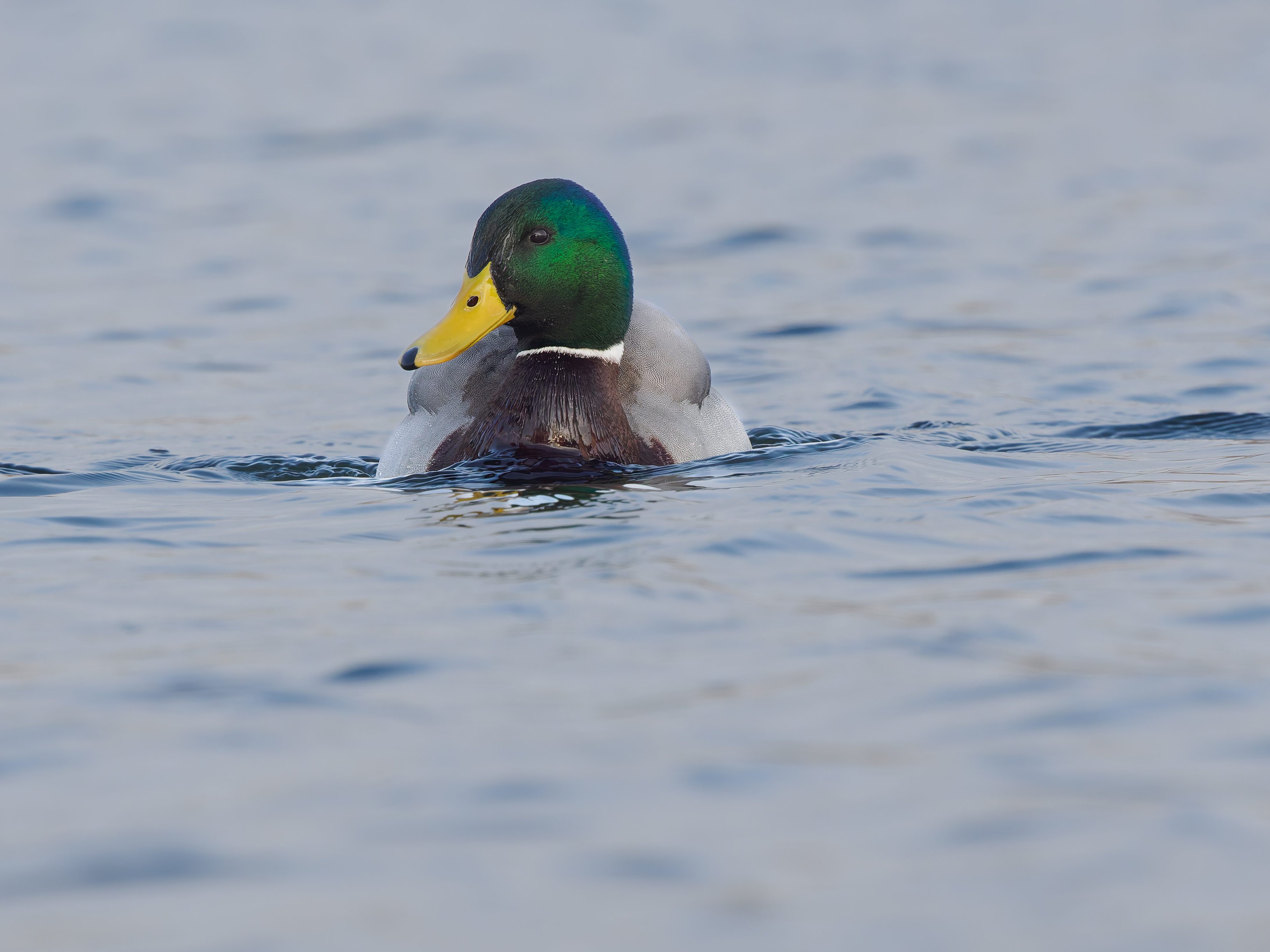
A selection of surveys carried out in the past.
2020 Great Duck Hunt
The 2020 Great Duck Hunt took place on the weekend of 11th-12th January.
 Goosander – Richard North
All water birds were counted including ducks, geese, swans, grebes, divers, rails and crakes, herons, kingfishers, cormorants, waders and gulls.
The 2020 results submitted
Lockdown Bird Race list (published 2020)
| The Basic List | |||
| 65 | 93 | 102 | |
| Species | Garden | Permissive walk/cycle | TOTAL for weekend |
| Greylag Goose | Y | Y | Y |
| Canada Goose | Y | Y | Y |
| Barnacle Goose | |||
| Egyptian Goose | Y | Y | |
| Shelduck | |||
| Mute Swan | Y | Y | Y |
| Mandarin | Y | Y | |
| Shoveler | |||
| Gadwall | Y | Y | |
| Mallard | Y | Y | Y |
| Teal | Y | Y | |
| Wigeon | |||
| Pochard | Y | Y | |
| Tufted Duck | Y | Y | |
| Grey Partridge | Y | Y | |
| Red-Legged Partridge | Y | Y | Y |
| Pheasant | Y | Y | Y |
| Little Grebe | Y | Y | |
| Great-Crested Grebe | Y | Y | |
| Cormorant | Y | Y | Y |
| Grey Heron | Y | Y | |
| Little Egret | Y | Y | |
| Buzzard | Y | Y | Y |
| Red Kite | Y | Y | Y |
| Marsh Harrier | Y | Y | |
| Sparrowhawk | Y | Y | |
| Hobby | Y | Y | |
| Kestrel | Y | Y | Y |
| Peregrine | Y | Y | |
| Water Rail | |||
| Moorhen | Y | Y | Y |
| Coot | Y | Y | |
| Lapwing | Y | Y | Y |
| Little Ringed Plover | Y | Y | |
| Ringed Plover | |||
| Oystercatcher | Y | Y | Y |
| Common Sandpiper | Y | Y | |
| Snipe | |||
| Redshank | Y | Y | |
| Black-Headed Gull | Y | Y | Y |
| Common Gull | Y | Y | |
| Herring Gull | Y | Y | Y |
| Lesser Blk-Backed Gull | Y | Y | Y |
| Common Tern | Y | Y | Y |
| Black Tern | Y | Y | |
| Rock Dove | Y | Y | Y |
| Stock Dove | Y | Y | Y |
| Wood Pigeon | Y | Y | Y |
| Collared Dove | Y | Y | Y |
| Turtle Dove | Y | Y | |
| Rose-ringed Parakeet | Y | Y | Y |
| Cuckoo | Y | Y | Y |
| Swift | Y | Y | |
| Kingfisher | Y | Y | Y |
| Tawny Owl | Y | Y | |
| Barn Owl | Y | Y | |
| Little Owl | Y | Y | |
| Great Spotted Woodpecker | Y | Y | Y |
| Green Woodpecker | Y | Y | Y |
| Jay | Y | Y | Y |
| Magpie | Y | Y | Y |
| Jackdaw | Y | Y | Y |
| Rook | Y | Y | Y |
| Carrion Crow | Y | Y | Y |
| Raven | Y | Y | Y |
| Skylark | Y | Y | Y |
| Sand Martin | Y | Y | |
| Swallow | Y | Y | Y |
| House Martin | Y | Y | Y |
| Great Tit | Y | Y | Y |
| Blue Tit | Y | Y | Y |
| Marsh Tit | |||
| Coal Tit | Y | Y | Y |
| Long-Tailed Tit | Y | Y | Y |
| Bearded Tit | |||
| Wren | Y | Y | Y |
| Nuthatch | Y | Y | |
| Eurasian Treecreeper | Y | Y | |
| Cetti’s Warbler | Y | Y | |
| Grasshopper Warbler | |||
| Willow Warbler | Y | Y | |
| Chiffchaff | Y | Y | Y |
| Sedge Warbler | Y | Y | |
| Reed Warbler | Y | Y | |
| Blackcap | Y | Y | Y |
| Garden Warbler | Y | Y | Y |
| Whitethroat | Y | Y | Y |
| Lesser Whitethroat | Y | Y | |
| Goldcrest | Y | Y | Y |
| Firecrest | |||
| Wheatear | Y | Y | |
| Black Redstart | Y | Y | |
| Stonechat | |||
| Whinchat | Y | Y | |
| Nightingale | Y | Y | |
| Robin | Y | Y | Y |
| Blackbird | Y | Y | Y |
| Ring Ouzel | |||
| Song Thrush | Y | Y | Y |
| Mistle Thrush | Y | Y | |
| Starling | Y | Y | Y |
| Dunnock | Y | Y | Y |
| Spotted Flycatcher | |||
| Pied Wagtail | Y | Y | |
| Yellow Wagtail | Y | Y | |
| Grey Wagtail | Y | Y | |
| Meadow Pipit | Y | Y | |
| Corn Bunting | Y | Y | |
| Yellowhammer | Y | Y | |
| Reed Bunting | Y | Y | Y |
| Chaffinch | Y | Y | Y |
| Greenfinch | Y | Y | Y |
| Goldfinch | Y | Y | Y |
| Bullfinch | Y | Y | Y |
| Linnet | Y | Y | |
| Lesser Redpoll | |||
| Siskin | |||
| House Sparrow | Y | Y | Y |
| Tree Sparrow |
2019 Swift and previous House Martin Surveys
Swift Survey
Swifts, like House Martins, are declining in number and are now included on the Birds of Conservation Concern amber list. Graham Bellamy is hoping to start a Swift Action Group for Bedfordshire, details of which will appear on the website and on the BedsBirds email group. In the meantime, we would like to start collecting information on where birds are breeding in the county. As House Martins and Swifts nest in similar locations, it seems sensible to combine the surveys.A Swift survey was started with the BTO House Martin survey of 2015 onwards as they, like House Martins, are declining in number and are now included on the Birds of Conservation Concern amber list. Graham Bellamy is hoping to start a Swift Action Group for Bedfordshire, details of which will appear on the website and on the BedsBirds email group. In the meantime, we would like to start collecting information on where birds are breeding in the county. As House Martins and Swifts nest in similar locations, it seemed sensible to combine the surveys.
House Martin Survey
2017 saw the third year of the BTO House Martin survey which is a nest study with the aim of monitoring the activities that take place over the course of the breeding season at individual nests with the emphasis on timing of nesting activity, the number of broods and outcome of nesting attempts. Full details are available on the BTO website, from where you can log in or register to the House Martin Nest Study, and download the forms and instructions in preparation for the start of the survey. If you registered for the 2015 survey you will be able to log in and will not need to register again this year.
You can select your own site(s) to monitor. The BTO would prefer complete coverage of a small number of nests rather than partial coverage of a many. With this in mind please consider selecting a subset of nests if your local colony is large. House Martins are now starting to arrive at their colonies. Please try to start recording by the end of May at the very latest, or sooner if possible so that we can obtain information about the state of the nests before breeding activity begins in earnest.
Prompted by the poor results from last year’s BTO Survey, when House Martins where found nesting in only 8 of the 59 randomly allocated squares that occurred in Bedfordshire, it has been decided to run a county-wide House Martin survey in the summer of 2016. Please record all nesting House Martins that you find in the county, noting date, grid reference, place and address of nest site plus number of nests. For consistency with the BTO survey, a House Martin colony is defined as one or more nests on a SINGLE building or structure. Please provide information for each building separately, even if several buildings close together have House Martin nests. It would also be interesting to receive negative returns from areas where House Martins have nested previously but are absent in 2016.
During fieldwork for the most recent atlas (2007 – 2011) House Martins were confirmed breeding in 175 of the 378 tetrads that comprise Bedfordshire with probable breeding in a further 42 tetrads. It would be good if coverage for this survey could match that of the atlas.
Common Swift and House Martin breeding data
Populations of Common Swift Apus apus and House Martin Delichon urbicum are declinin. As a result, both species are Amber listed; Birds of Conservation Concern 4 (Eaton et al. 2015). Both species breed on or in buildings, which may be subject to demolition or renovation, resulting in the loss of breeding sites; acknowledge as one of the probable causes of the population declines. In order to mitigate this impact, we need to know where the birds are breeding. Therefore, we are asking birders and members of the Bedfordshire Bird Club to submit records of known breeding sites. To do this effective, the records will need to contain the following information:
- Species; record the number of birds seen, including records of low-level (roof-top height) screaming parties,as this is indicative of a nearby breeding colony; plus the number of nest sites (for Swifts this will be the number of entry points to a roof).
- It may be useful to record breeding activity using BTO codes where applicable; these have been revised specifically for Swifts:
Probable:
- P: pair in suitable nesting habitat.
- T: permanent territory (defended over at least 1 week).
- D: courtship and display (include low-level screaming parties of Swifts).
- N: visiting probable nest site.
- A: agitated behaviour.
Confirmed:
- FL: recently fledged young seen in flight; include low-level screaming parties of Swifts seen in July.
- ON: adults entering or leaving nest site indicating occupied nest.
- FF: adult carrying faecal sac or food for young.
- NY: nest with young seen or heard.
A full address of the property; house number/name, street name, town; 1km grid square reference.
- Enter your records on to the RSPB website at: (https://emisapps57.erm.com/Rspb/Inventory/SwiftFlying)
References.
Eaton, M A., Aebisher, N J., Brown, A F., Hearn, R., Lock, L., Musgrove, A J, Noble D G., Stroud, D G., and Gregory, R D. (2015). Birds of Conservation Concern 4: the population status of birds in the United Kingdom, Channel Islands and the Isle of Man. British Birds 108: 708-746.
Bedfordshire Bird Club, Records & Research Committee:
Graham Goodall. Research Officer.
Roger Hicks. BTO Regional Representative.
Steve Blain. County Bird Recorder.
2017 Waterways Breeding Bird Survey
The Bird Club survey for 2017 is a Waterways Breeding Birds Survey. So, if you would like to enhance a walk along your local river or canal, please consider giving it a go.
When you have chosen your survey route, make a note of the start and finish points using 1km squares or specific grid references; plus place names where applicable.
Please inform Graham Goodall of your chosen route in order to avoid duplication
Survey methodology
(Download as document HERE)
The route you choose should keep as close as possible to the edge of the watercourse; ideally, within 25 metres of the water’s edge. The length of the survey is up to you, but please bear in mind that you will probably need to retrace you route to get back to your car if you have driven to the site. The survey route should be a minimum of 1km (one way); 2km or more would be better. Record the birds you see or hear with 25 metres either side of your route. Surveys should be carried at least four weeks apart, as follows:
- First survey: mid-March to mid-May.
- Second survey: mid-May to mid-July.
Surveys should be conducted during the morning; ideally, between the hours of 6 – 11am and should be conducted in good weather conditions.
1. Use the survey sheet to record the birds you see during the two surveys. It is important that you include breeding codes for each species; see below.
2. Please enter all your survey records on to BirdTrack, BTO website.
3. Send your survey sheet to Graham Goodall, Research Officer
Surveys should be conducted during the morning; ideally, between the hours of 6 – 11am and should be conducted in good weather conditions (categories 1 and 2).
Cloud cover___________________ Rain___________________ Wind___________________ Visibility
0-33%? ___ – 1___________________ none___________________ – 1___________________ Calm___________________ – 1___________________ Good ___________________ ___________________ 1
33-66%_____________________ – 2_____________________ Drizzl e- 2___________________ Light- 2___________________ Moderate – 2
66-100% – 3___________________ Showers 3___________________ Breezy 3___________________ Poor- 3
Breeding Codes.
Possible:
- H: species seen in suitable nesting habitat.
- S: singing male in suitable breeding habitat.
Probable:
- P: pair in suitable nesting habitat.
- T: permanent territory (defended over at least 1 week).
- D: courtship and display.
- N: visiting probable nest site.
- A: agitated behaviour.
- I: brood patch of incubating bird (seen on bird in the hand).
- B: nest building or excavating a nest hole.
Confirmed:
- DD: distraction display or injury feigning.
- UN: used nest or eggshells found from current season.
- FL: recently fledged young or downy young.
- ON: adults entering or leaving nest site in circumstances indicating occupied nest.
- FF: adult carrying faecal sac or food for young.
- NE: nest containing eggs.
- NY: nest with young seen or heard.
WATERWAYS BREEDING BIRDS SURVEY 2017: SPECIES LIST.
Name of watercourse: _____________________________________ Grid references: names, start : finish._____________________ Length (km).
_____________________
Survey Dates: 1._____________________ 2.
_____________________ Survey One._____________________ _____________________ Survey Two.
| Species | Count | Breeding code | Count | Breeding code |
| Mute Swan | ||||
| Greylag Goose | ||||
| Canada Goose | ||||
| Barnacle Goose | ||||
| Egyptian Goose | ||||
| Shelduck | ||||
| Mandarin Duck | ||||
| Eurasian Wigeon | ||||
| Gadwall | ||||
| Eurasian Teal | ||||
| Mallard | ||||
| Garganey | ||||
| Northern Shoveler | ||||
| Red-crested Pochard | ||||
| Common Pochard | ||||
| Tufted Duck | ||||
| Goosander | ||||
| Cormorant | ||||
| Bittern | ||||
| Little Egret | ||||
| Grey Heron | ||||
| Little Grebe | ||||
| Great Crested Grebe | ||||
| Water Rail | ||||
| Moorhen | ||||
| Coot | ||||
| Northern Lapwing | ||||
| Black-headed Gull | ||||
| Lesser Black-backed Gull | ||||
| Herring Gull | ||||
| Great Black-backed Gull | ||||
| Common Tern | ||||
| Kingfisher | ||||
| Sand Martin | ||||
| Willow Warbler | ||||
| Sedge Warbler | ||||
| Reed Warbler | ||||
| Grasshopper Warbler | ||||
| Yellow Wagtail | ||||
| Grey Wagtail | ||||
| Pied Wagtail | ||||
Thames and Chiltern Bird Atlas (Bird Atlas 2007-11)
The atlas provides data on bird distribution, breeding and wintering densities, and habitat information in southern England, serving birdwatchers, policy makers, and scientists researching conservation and population changes.
2002 Spotted Flycatcher Survey
This survey was coordinated by Richard Bashford.
Spotted Flycatcher has always been one of my favourite birds. Indeed, a pair nesting in my Sandy garden in the late 1970s stimulated my interest in birdwatching. In recent years, despite almost daily birdwatching, I have been struck by how few records I’d collected in the course of a year. The only birds I was recording were those seen where I worked (in the Nunnery Grounds in Thetford, in the Lodge grounds in Sandy) or in Moggerhanger churchyard opposite my parents house. My experience seemed to be reflected in the records sent in to the Bedfordshire Bird Club with only 10-15 breeding pairs being reported annually. One just didn’t come across Spotted Flycatcher in the course of normal birdwatching. Now red listed (greater than 50% decline over that last 25 years), it is also classed as a species undergoing rapid long term decline (1970-1999) – source BTO. As the species has declined, it seems to have moved away from the more usual and expected breeding areas such as woodland and gardens and can now only be found in perhaps, more optimum habitats such as churchyards and large mature gardens. Smaller numbers could be found in woodland.
I wondered whether a concerted effort looking for this species in these habitats would paint a truer picture of this species distribution in the county. Would the county’s birdwatchers take up the challenge and leave their gravel pits for a few minutes and check out that churchyard!
Time was short since I started thinking about this in late June, and the birds already present in the county for some six weeks. Clearly there was no time to print a request in the club newsletter to encourage people out into the field. However, the active and well supported Bedsbirds email group was a different story. With around 130 members at that time, and following the rush of emails following Nigel Wood’s requests for Little Owl records a week or so before, I requested any Spotted Flycatcher records on 26 June. I asked specifically for dates and number of birds seen (to help ascertain breeding), and six figure grid reference. At a similar time, David Kramer contacted me on behalf of the Bird Club’s Research and Records Committee. Spotted Flycatcher was one of four species for which they required more information and highlighted the need to collected grid references and evidence of breeding.
It was a bad start with the first four replies being negative. However, my own efforts and those of Tim Sharrock started to collect a few records from churchyards. This developed into a coordinated search of north and east Bedfordshire churchyards over the first few days of July. By the 9th, more people were beginning to contribute and by the middle of the month, there were many people searching and sending in records. By this time, I decided to be a bit more proactive. I spent a bit of time creating a spreadsheet of all the county’s churchyards and contacted various, strategically placed birders to ask if they would mind checking specific churchyards. Since I had no idea which of the churchyards were likely to hold Spotted Flycatchers, I asked the observer to comment on suitability. Peter Almond in particular (working as a volunteer at the Lodge and so easily collared by me!), kindly checked over 20 sites – some more than once, and personally found around 15 pairs. As the end of the month arrived, I estimated Bedfordshire birders had visited at least 90% of the county’s churchyards alongside numerous other woodland and garden sites.
Some interesting results were starting to emerge. In particular, Tim Sharrock and I visited the same churchyards on different days and collected very different results, suggesting one visit was not enough to confirm presence. Recent RSPB fieldwork on this species suggests that as few as one visit in three will detect a pair.
By the 27 July, Steve Blain created and posted a map onto the Bedsbirds website of the 70-80 pairs so far recorded.
A few more records came to light in emails during August and via the Bird Club Website, where a request for records had been placed by Andy Banthorpe. A request for all Spotted Flycatcher records was also placed in The Hobby. At the end of the year when record cards were returned, I augmented more non email records to the database. Finally, a couple more pairs were confirmed through the bird club’s garden bird survey organised by Barry Nightingale.
Results
One hundred and twenty two emails were received as a result of my request.
I asked for records of all birds seen and negative records from sites where they were recorded in the previous year. Despite the worrying start to the survey, only eight sites fell into the latter category. The map shows confirmed pairs (94), including five sites with two pairs and four sites with three pairs. In addition, there were 28 sites where only single birds were recorded. Most of these were from suitable breeding areas, so given more time it is likely that more breeding pairs could be confirmed.
To provide an indication of the breadth of coverage, I have included those 74 sites (90% of which were churchyards) that were searched but no birds found. It is worth noting that not all these churchyards would be suitable for Spotted Flycatchers and at least 18 were recorded as unsuitable. At least 40 were recorded as suitable.
Summary and conclusion
A simple and immediate request for records for a particular species via email has provided the county with truer picture of Spotted Flycatcher distribution. While the species has declined sharply across the UK in recent years, and retreated to its optimum habitat, (and away from the more usual sites visited by birdwatchers!), a coordinated effort to visit suitable areas has resulted in an increased in the number of breeding pairs recorded from around 15 to 94 pairs.
A similar survey of churchyards in five/ten years time would enable us to measure the local population of this species.
In addition, the relative ease of organising the survey, suggests that surveys for other species should be organised for the benefit of our local bird life.
 Spotted Flycatcher – Richard Bashford
Thanks
Many thanks to all the countys birdwatchers who contributed to this survey.
Richard Bashford, 6 Brook Road, Eaton Ford, St Neots, Cambridgeshire PE19 7AX
The Breeding Ecology of Spotted Flycatchers an RSPB study
Introduction
In 2002, a Spotted Flycatcher survey carried out by Bedsbirds emails group subscribers and members of the Bedfordshire Bird Club identified around 94 pairs. The RSPB were looking for suitable areas for a pilot study into the breeding ecology of Spotted Flycatchers. The Society approached the club to see if the data collected in 2002 could be used for this project. The 2002 dataset was supplied to the RSPB who identified a suitable study area in northeast Bedfordshire. The results of this study by Will Kirby, Katrina Black, Sarah Pratt and Richard Bradbury are summarised below
SUMMARY:
The project was based largely in northeast Bedfordshire and set out to trial research methods and inform planned future autecological study of the species. The project focussed on adult territory and nest monitoring, chick growth and survival, invertebrate prey and habitat assessment. Standard research methods were found to be largely applicable in terms of territory and nest monitoring, although locating territories without prior knowledge proved difficult due to the cryptic behaviour of the species. Colour ringing of nestlings is feasible and re-sighting is relatively simple, due to perching behaviour. Adult colour ringing should be possible and would be highly advantageous. Malaise trapping was found to adequately sample their favoured prey (diptera), but is time consuming in terms of trap erection and subsequent sample analysis. Focal area counts of insect activity were quick, simple and repeatable in a variety of habitats, but could not be correlated to simultaneous malaise trap results. Novel measures of habitat heterogeneity proved workable and results suggest they may provide a key insight into habitat requirements. Birds begin nesting shortly after arrival on territory, and results from this study show early season nests to be more successful than later ones. There was a suggestion that nests on buildings were more successful than those on trees.
Study Sites
Information gathered by members of Bedfordshire Bird Club in 2002 provided the basis of study site selection. As part of a survey, members were asked to record sightings of spotted flycatchers in their local area, churchyards were suggested as good potential sites.
With birds located from over 80 sites in Bedfordshire in 2002, around 25 of the sites in the Northeast of the county were chosen for re-survey in 2003. Other sites were added where cold-searching potentially suitable areas found birds, or where information was received following requests to various interest groups. In all, 14 of the 39 sites searched in Bedfordshire were occupied and followed throughout the season, along with a similar number of unoccupied sites to be used for habitat comparison purposes. Reports of a small number of birds in wholly woodland habitats were received, but we were unable to locate any despite numerous visits, hence the study focused largely on churchyard and rural garden sites.
This study has proved that the techniques investigated were generally suitable for further study of the spotted flycatcher. Indeed, even within the scope of the pilot, some interesting results have become apparent. A few data sets collected have yet to be fully analysed; these include forage watches, nestling faecal samples and video recordings from two nests. It is anticipated that further examination of these will be carried out on these as part of future study.
An extremely wide variety of sites were used for nest placement, ranging from holes or platforms in walls and trees, through creepers on walls and trees to open nests on boughs and disused nests of other species. Height of nests ranged from 1.3 to 10m. Given that virtually all potential territories would contain at least some of the above, it seems extremely unlikely that the spotted flycatcher is nest-site limited. There is a suggestion (albeit non-significant) from the results obtained that those nesting on trees are more likely to fail than those nesting on or in buildings. If this is the case, the most likely explanation is that predation risk is increased for tree nesters. It is known that numbers of some potential nest predators (eg corvids, grey squirrel) are increasing and it is likely that these may predate tree nests more readily than those on buildings, due to ease of access. Although there is no evidence from nest record data that nest success rates are declining per se, further investigation of the data to include nest site may be worthwhile. The greater success rate of higher nests in this study would also suggest predation (from ground based predators) as the causal factor, although again there is no evidence from nest records, without further investigation, that predation incidents are increasing.
In terms of habitat, there is a difference between occupied and un-occupied churchyards in that sites with greater heterogeneity are more likely to contain breeding spotted flycatchers. This could be due to a simple preference for specific foraging habitat types, or it may be linked to increased invertebrate abundance within a more varied habitat. It is known that farmland has become more homogenous over recent decades with a move away from mixed farming, loss of hedgerows and crop specialisation. Trends in woodland, parks and gardens are less well documented but it would certainly seem unlikely that heterogeneity has increased. The suggestion that big (mature) trees may be an important factor influencing territory selection could provide possible mechanisms for decline in parts of the UK where Dutch Elm Disease has greatly reduced the number of these since the early 1970s. Twenty million trees have been lost nationwide (Aboricultural Information Exchange) and this loss has been a suggested factor in the decline of a number of other species, including mention in the BAP for tree sparrow.
A healthy and available supply of invertebrate food is an obvious requirement for successful breeding of this obligate insectivore. They have a marked preference for larger invertebrates and favour diptera as prey, particularly when feeding chicks (Davies 1977). Although there is evidence of widespread declines in invertebrate abundance on farmland (eg Benton et al 2002), trends in woodland and garden habitats are not well understood. Malaise trap samples from this study suggest that the proportion of large and small diptera in our samples are not very different from those obtained by Davies in the mid 1970s, however overall numbers have not been compared, and indeed annual and site differences would render such comparisons inconclusive. There was little substantive evidence from this study that lack of food was impeding breeding success. Breeding started rapidly after arrival of adult birds on territory, suggesting that adult condition was not a limiting factor. There were only three known cases of brood reduction out of the 20 nests that went on to fledge at least one chick, another indication that food shortage was not particularly apparent.
Of the eleven failed nests (Cambs and Beds), three were known second nesting attempts after successful first broods, all three of these failures were due to abandonment (two at egg stage and one at nestling stage). All coincided with periods of bad weather. The other eight failed nests are assumed predated; although it is possible that predation occurred subsequent to death of the chicks. Despite the observed failures, a calculated nest success rate of over 50% is high for an open nesting passerine species, and would suggest that, given the ability to re-lay, pairs should manage to raise at least one brood.
From this study and other sources (e.g. Snow and Perrins 1998) a proportion of breeding pairs can manage to raise two, even occasionally three, broods in a season. Summers-Smith (1952) estimated from early nest record data that around 20% were double brooded. The amount of pairs achieving this level of production is likely to have a large effect on future populations. If most pairs (as suggested from this study) have only one successful brood fledging an average of 3.1 chicks, the annual survival rate would have to be high (for a small trans-Saharan migrant passerine) for the population to be maintained. There are many possible causes that could lead to a reduction in the number of breeding attempts per season, including shortening of the breeding season due to climate change and shortage of food leading to reduced adult fitness. From current available information, it is not possible to say whether there has been any change in the number of pairs fledging more than one brood, but elucidating this is considered a primary concern for future research.
One outstanding question that needs to be addressed alongside the detailed breeding ecology of the spotted flycatcher, before effective conservation measures can be prescribed, is to establish the primary habitat of the species, which may vary across the UK. We know that it breeds in woodland, farmland and both rural and urban parks and gardens, but it is not apparent from the current literature which, if any of these habitats is of primary importance. Each habitat is however fundamentally different, and it is unlikely that any future prescriptions could be developed that would span all habitats. It is equally likely that if the recent declines are connected with problems on the breeding grounds, rather than in wintering areas or on migration, there are likely to be different factors involved in the different habitats. A multi-faceted approach to future research is deemed essential.
Heronries – BTO Survey
The BTO Heronries Census began in 1928 as a one-off investigation but has matured into an annual survey still ongoing more than 90 years later and is one of the longest running breeding bird survey in the world. The simple aim of the Heronries Census is to collect counts of apparently occupied nests (aon) of herons, egrets and other colonial waterbirds, e.g. cormorants from as many heronries as possible in the UK each year. In the latest Bedfordshire Bird Report details are recorded for five heronries. The following table lists these and other locations where herons have nested over the years. In recent years Herons have started nesting in the disused clay pits, e.g. Coronation and Rookery North pits, and may also have nested in other similar locations. If anyone is able to visit these sites to confirm whether or not these heronries are active, that information would be gratefully received as would any nest counts from active colonies (whether on the list or not).
| Heronry | GridRef | Currently Active |
| Battlesden Lake | SP957287 | |
| Blunham Lakes | TL158510 | Yes |
| Bromham Park, Biddenham | TL019512 | |
| Coronation pit | Yes | |
| Harrold-Odell CP | SP963573 | Yes |
| Ickwell Bury | TL1445 | |
| Little Barford | TL180571 | |
| Luton Hoo | Yes | |
| Priory CP, Bedford | TL075491 | Yes |
| Radwell Gravel Pits | TL007589 | |
| Redstone Hill, The Lodge, Sandy | TL183485 | |
| Rookery North pit | TL010410 | |
| Rushmere CP | SP913284 | Yes |
| Southill Park Lake, Old Warden | TL144428 | Yes |
| Stratford, Sandy | TL184474 | |
| Tempsford Hall, Tempsford | TL171535 | |
| Turvey House, Turvey | SP937528 | |
| Tusting | SP952572 | |
| Willington Gravel Pits | TL100504 | |
| Woburn Park | SP961325 | Yes |
For more information, including how you can take part, please visit the BTO Heronries census web pages at https://www.bto.org/our-science/projects/heronries-census
or contact Roger Hicks at: rogerkhicks@hotmail.com
BTO Regional Representative for Bedfordshire