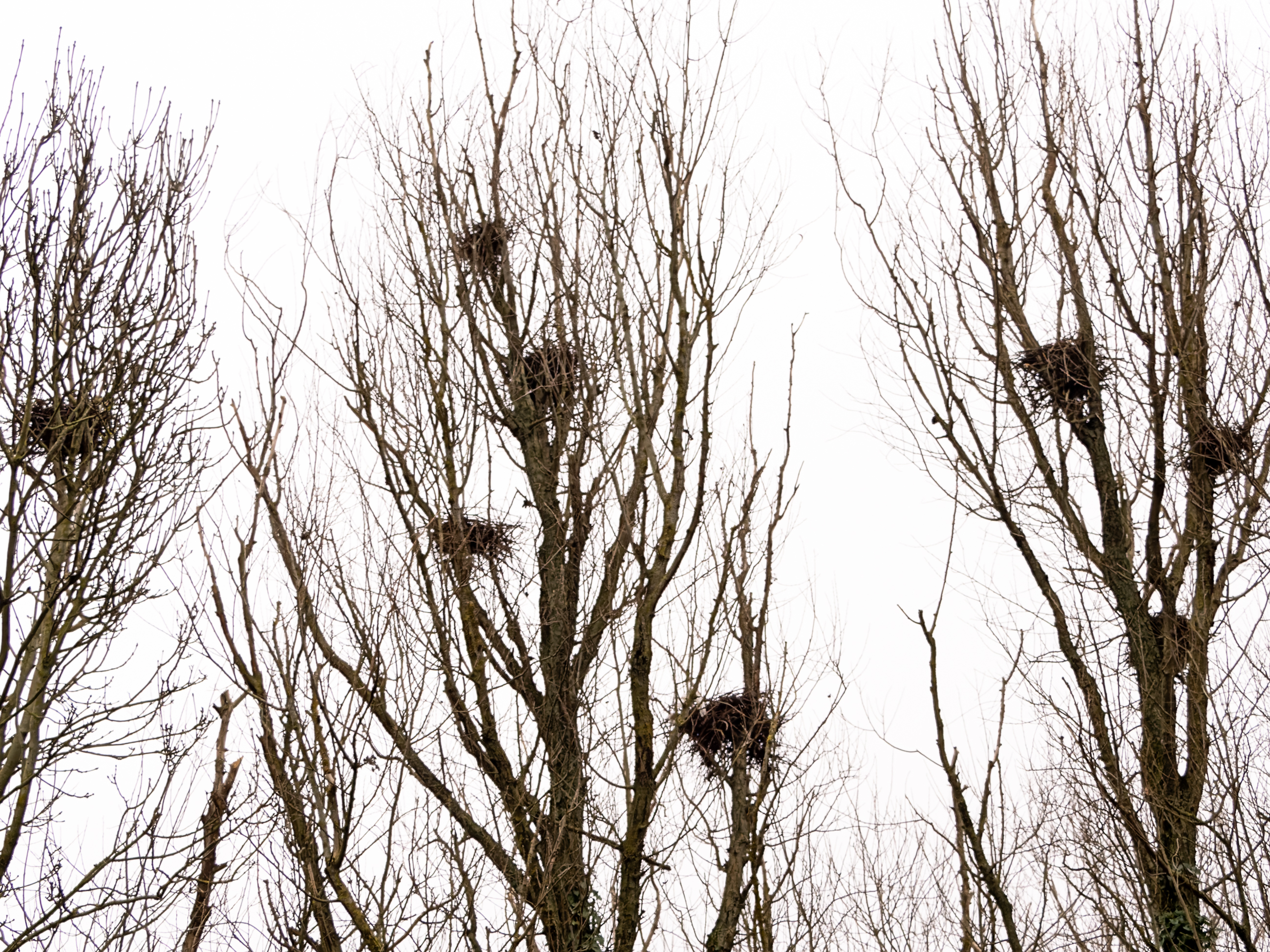
Roger Hicks kindly masterminds this annual survey and any outstanding rookery counts whether from new rookeries or updating earlier counts would be gratefully received. Please email rogerkhicks@hotmail.com.
Please look for and report on Bedfordshire Rookeries.
2026 Rookery Survey (current)
The current distribution of rookeries in the county can be seen on this Google Map overlay:
All rookeries used in the last five years (i.e. 2021 – 2025) are shown. The yellow markers are rookeries used in 2025, while the orange markers are those which were not visited or where there were no nests in 2025. As the survey progresses, the markers of rookeries that are active in 2026 will be changed to green and those where there are no nests or nesting activity will be changed to red.
 Rook – Steve Blain
So far this year counts have been received for 20 active rookeries for a total of 355 nests. This total already includes two new rookeries. One in Upper Caldecote on the corner of Ashby Drive held remains of nests in January, so was probably used last year (although not included in the totals). I wonder if these birds are those that were displaced when trees were felled in the nearby Upper Caldecote rookery. And one in the small copse beside Hill Lane (between Biggleswade and Upper Caldecote or between Sainsbury’s and G&M) which held a small rookery up until about 2011 or 2012 when it was shot out and has not been used since.
Nests are still being built in most rookeries that I have visited. In my local rookery nine nests remained after the winter gales, there were 13 nests on 11th Feb, 16 on 12th Feb, 18 nests on 20th Feb and 30 nests today. One pair have been trying to build a nest since last Thursday, they get as far as a platform of sticks and then something happens and they have to start again. I am not sure what that something is but they are still trying today. There was nothing when I headed out on my morning walk and a small platform when I returned.
I have created a Google Sheet (link below) showing all rookeries recorded since the current survey started in 2013. The rookeries reported in the last five years (2021-2025) are at the top of the list. Those used last year are in bold. Please enter: Observation Date, Number of Nests, Your Name and any relevant notes. A nil count should be entered for a rookery that has been abandoned or where there are no longer any nests. Cells with records will be manually locked after data has been entered. To submit an updated count or a new rookery please send details to my personal email (above).
2025 Rookery Survey
The distribution of rookeries in the county can be seen on a Google Map at: https://tinyurl.com/BedsRookeries2025.
 Rook – Steve-Blain
All rookeries used in the last five years (i.e. 2021 – 2025) are shown. The yellow markers are rookeries used in 2025, while the orange markers are those which were not visited or where there were no nests in 2025. As the survey progresses, the markers of rookeries that are active in 2026 will be changed to green and those where there are no nests or nesting activity will be changed to red.
2025 was a good year with 5005 nests counted from 200 rookeries. Three rookeries held more than 100 nests and average colony size increased to 25.5 nests (compared to 22.5 in 2024). Not all previously used sites were visited this year but 12 new (or least not previously reported) rookeries were recorded. Ash was the most commonly used nest tree (42% of nests) but 34% of nest trees remain unidentified.
2024 Rookery Survey
The distribution of rookeries in the county can be seen on a Google Map at: https://tinyurl.com/BedsRookeries2024.
 Rook – Rod Patterson
As the trees leaf up, it is becoming more difficult to see, let alone count Rooks’ nests. Also, some rookeries are now beginning to fall silent as the chicks leave the nest, although the chicks can usually be found nearby noisily begging from their parents. On Henlow sports field, a couple of recently fledged Rooks even chased a jackdaw begging for food, they did not get lucky.
Counts have been received from 205 rookeries giving a total of 4,613 nests. One site has been noted as active but no nest count was possible. The only regularly used sites for which no counts have been received this year are for those rookeries within the Chicksands base. Eleven new (or at least previously unrecorded) were reported. A further 76 sites which had previously held rookeries have also been checked.
Compared with 2023, which was a bumper year, a similar number of rookeries have been recorded but 450 fewer nests. There are no obvious reasons why this has happened. Average colony size is lower 22.5 (compared with 24.84 in 2023) and continuing the trend towards more but smaller (by nest count) rookeries.
2023-2013 Rookery Surveys
In 2013, Roger Hicks began a project to map Bedfordshire’s rookeries which has become annual and is continuing in 2023.
Rookeries 2023
Incomplete coverage of the county last year, due to a variety of reasons, resulted in fewer rookeries and nests being recorded. Counts were received from 169 rookeries with a total of 3505 nests. This was well down on the record totals recorded in 2021 (213 rookeries and 4823 nests).
Rooks have started congregating in the nest trees of my local rookeries and perching by or on the remaining nests. I have not yet seen any evidence of nest building. Now can be a good time to locate rookeries as birds milling about above the nest sites are often visible from some distance, and of course the nests are easy to spot in leafless trees. I have a fledgling theory that the number of birds noted perched in rookery trees at this time of year closely equates to the number of pairs that will attempt to nest.
I am hoping for to achieve better coverage of the county this year than last. If you would like to contribute to the survey, all rookery data will be gratefully received. For each rookery I am collecting: Rookery Name, ordnance survey grid reference, count date, nest count and, if possible, species of tree with number of nests per tree species. The results can be followed on a google map at
https://tinyurl.com/BedsRookeries2023
All known rookeries are shown with yellow or orange markers. The yellow markers are rookeries used in 2022, while the orange markers are rookeries which were not visited or where there were no nests and no activity in 2022. As the survey progresses, the markers of rookeries that are active in 2023 will be changed to green and those where there are no nests or nesting activity will be changed to red.
For comparison with past (and future) surveys a rookery is defined as any nest or group of nests more than 100m from the next nearest nest or group of nests. A rookery can consist of only one nest.
The majority of rookeries recorded so far have been beside or visible from a road. Please let me know, if you come across any that are off the beaten track. I would also like to collect any historical counts that may be lurking in your notebooks.
I still find identifying the nesting trees more difficult than expected, especially when without leaves and once in leaf it was difficult to count the nests! Ash is the most commonly used nest tree but a large proportion of nest trees still remained unidentified.
Previous recent Rookeries surveys
http://tinyurl.com/BedfordshireRookeries2018
http://tinyurl.com/BedsRookeries2017
http://tinyurl.com/BedsRookeries2016
Rookeries 2015
The Bedfordshire Rookeries survey results are shown in the base map at BedsRookeries2015
Rookeries visited in 2015 are marked green; rookeries no longer used are marked red.
Rookeries 2014
Results from 2014 survey can be found at BedsRookeries 2014
Rookeries 2013
The first year of a project to map Bedfordshire rookeries. With the help of BedsBirders and Bedfordshire Bird Club members the location of 135 active rookeries were mapped with a total of 3744 nests counted.
The map can be viewed below or at BedsRookeries 2013. The active rookeries are marked in blue; sites where rookeries had previously been recorded (in recent years) are marked in red; sites with rookeries in previous years but not visited in 2013 are marked in yellow. The south and west of the county were poorly covered in 2013. Comparison with the atlas map for 2007-2011 suggests about 70 rookeries were ‘missed’. A spreadsheet of the 2013 results is available for those interested, please email and I will send out a copy.
More Historical Bedfordshire Rookery Surveys
The first national census of rookeries was conducted in 1944-46 as part of the war effort to determine if Rooks adversely affected food production. A second national census was carried out in 1975 after various local reports of declines in Rook numbers. Thanks to the Alexander Library (at Oxford Uni) and the BTO I have been able to extract the Bedfordshire data from both these censuses. I have created Google maps from both data sets and these may be viewed at:
Roger Hicks
(to contact Roger please use: rogerkhicks @hotmail.com)